The tug-of-war between excellence and mediocracy

Ever since the beginning of industrialisation, there is no end to programs meant to bring the best out of organisations. There are time studies, Management-by- Objectives, Balanced Scorecard, ISO standards, Total Quality Management, Business Excellence Model, Lean Six Sigma, Design Thinking, Agile and more. While many are still being adopted by organisations, there seem to be no silver bullet. Each approach gets popular for a while before they receive criticism and fade away, only to be replaced by new-found fad. Why is it so difficult to get them to work for organisations?

A clue may just lie around us. In our day-to-day life, we may at times think about slimming down, getting fit, or introducing changes to our lifestyle. But it is rare to see people follow through and sustain the effort. Usually, there will be temporary success, before complacency or distractions set in and derail our efforts.

This is because our thoughts arise in formation and tend to follow the same comfort zone as in the past. Without any push/ pull factors or anchor, our behaviors will have the tendency to fall into complacency or mediocracy. In an organisation of many, complacency will tend to set in at all levels, from the leaders to frontline employees. It is common to see people giving themselves easy targets, and give excuses at times of failure.

In particular, programs that push for excellence often calls for changes outside our comfort zone. Much like athletes having to go through hours of laborious training and muscle aches to win the gold medal, employees also need to make uncomfortable adjustment to adapt to new changes. Organisations may push through the program and make it mandatory for people to follow, but it is harder to win the heart and mind and make the change lasting. Without the right anchors and control, the new behavior may not stick and there is always the danger of falling back to the status quo after that award is won or when there is a change in leadership.

The key in transformation lies in developing people, winning their heart and mind, and to establish anchors & controls to make the new behavior stick. It is easy to copy activities like suggestion scheme, work improvement teams and visual boards. But, it is more important and more challenging to develop people in their mindset, belief and habits. There is no shortcut about it.

In Toyota, developing people and respecting people’s ability and potential is centre-piece of their continuous improvement effort. They establish anchors and controls, like standard works, kata (routine for work and analysis discussion) and A3 reports, so that managers and employees develop PDCA habits in their daily work.

Like-wise, for any programme for transformation to be sustainable, it is necessary to develop people through the ranks so that everyone, from leaders to frontlines, has total understanding, belief and commitment in the change. The change must also be embedded into the work culture with anchors and controls, so that it becomes a habitual practice for all. It takes time, persistent effort, and a systemic approach and to make it works.

This is a tall call in many organisations. Uniting the hearts and minds and cultivating the right culture takes efforts & time, and is far harder than mandating compliance. Besides, it is often less rewarding for managers to develop people, than to simply deliver hard numbers and KPIs required. There is always the tempting option of proclaiming success with the superficial results (or blame the methodology), and then move on to the next fad to score new points.

This is why successful transformation is rare and exclusive. Only leadership team with the foresight, wisdom and commitment can pull through transformation successfully and make it last.
How organisations can achieve world-class performance

For many years, researchers and practitioners have endeavored to find the best way to manage work using science, so as to deliver great results effectively and efficiently. Scientific management gave birth to methods like process management, standardisation and mass production. Subsequently, the realisation about importance of meeting the diverse customers’ needs and demands, give rise to the concept of quality control and total quality management.

In the modern age, where competition is high, and consumers are pampered by the variety of choices that they have, it is common sense for organisations to deliver quality products and services consistently. If not, customer can always choose another brand or provider to fulfill their needs.

To be competitive, companies must deliver quaity products & services effectively and efficiently, and continuously improve to stay ahead of its competition.

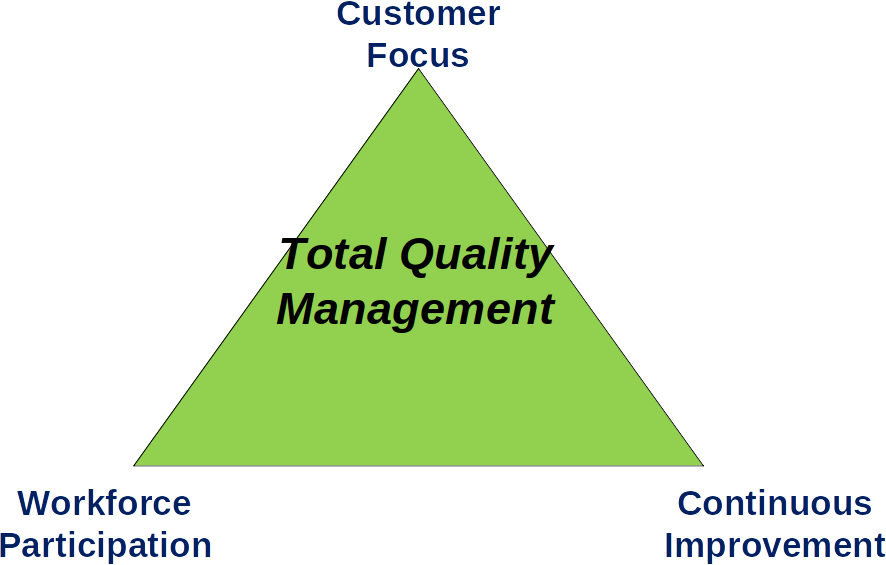
My favorite is the following three-pillar model to illustrate this concept of Total Quality Management.

The three key ingredients for companies to be competitive in its products & services are

1) Customer Focus – Understanding the needs and requirements of target customer segments

2) Continuous Improvement – Continuously improve products, services & processes to meet the evolving needs of the customers

3) Workforce participation – Get the entire workforce involved to work together on delivering quality and making continuous improvement.

It is easy to see the potency of this combination. We can only deliver quality products that win the heart of customers if we first understand customers’ needs. And we can only stay ahead of our competitors if we consistently improve on the value we deliver by getting our teams to work together. However, in big organisations, more considerations are needed in view of the complexity of issues involved. That is when the Business Excellence Model comes into the picture.

The most famous of the Business Excellence Models are

  • Deming Prize, established by Japan in 1951 to honor Dr Edwards Deming,
  • Malcolm Baldrige National Quality Award (MBNQA), established by the United States in 1987 to boost competitiveness of its enterprises.
  • European Foundation for Quality Management (EFQM) model, established by the European Union in 1989 to increase competitiveness of the European economy.

The MBNQA framework is often adapted by other countries to establish each’s own national quality award framework. This includes Singapore Quality Award, China Quality Award, Japan Quality Award, and Thailand Quality Award etc.

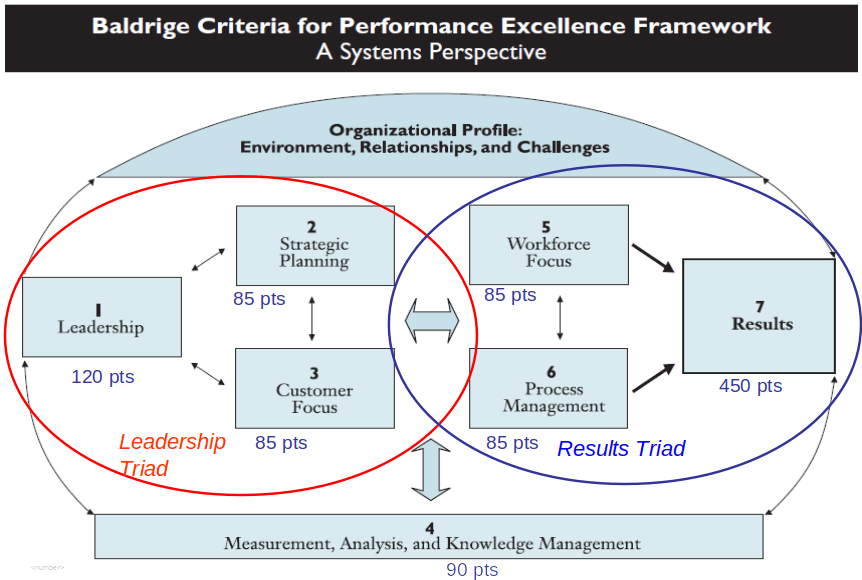
The Business Excellence Model, such as the MBNQA, has expanded on the traditional concepts of Total Quality Management, to cover fuller spectrum of modern management theories and discoveries. Lets take the MBNQA framework below as example.

Under the MBNQA model, an organisation needs to address critical success factors of its business, in order to be competitive. It has to develop and deploy strong and effective system for

  1. Leadership
  2. Strategic Planning
  3. Customer Focus
  4. Measurement, Analysis and Knowledgement Management
  5. Workforce Focus
  6. Process Management

All these major areas must be embeded with continuous learning and improvement, and they will in turn drive key business results in category 7. Category 1 to 3 provides direction for the company, and they are also known as “Leadership Triad”, while Category 5 to 7 directly drive results and are known as “Results Triad”.

I have used Business Excellence Model in assessment and in driving organisational improvement. I personally find it to be a very useful tool that enables organisations to identify where they are in development, and to identify where opportunities for improvement are. But it is a pity that many organisations only use the framework for national quality award purposes, much like students studying only to pass exams. This is a waste.

The best way for organisations to derive real and lasting benefit, is to embed Business Excellence as an integral part of the organisation’s work. Use it educate and develop managers and leaders. Use it to conduct periodic organisational reflection, benchmarking, and plan for improvement. Only then, can the organisation achieve true world-class performance and competitiveness, and deliver value to its customers and stakeholders .

Design a site like this with WordPress.com
Get started