For many years, researchers and practitioners have endeavored to find the best way to manage work using science, so as to deliver great results effectively and efficiently. Scientific management gave birth to methods like process management, standardisation and mass production. Subsequently, the realisation about importance of meeting the diverse customers’ needs and demands, give rise to the concept of quality control and total quality management.
In the modern age, where competition is high, and consumers are pampered by the variety of choices that they have, it is common sense for organisations to deliver quality products and services consistently. If not, customer can always choose another brand or provider to fulfill their needs.
To be competitive, companies must deliver quaity products & services effectively and efficiently, and continuously improve to stay ahead of its competition.
My favorite is the following three-pillar model to illustrate this concept of Total Quality Management.
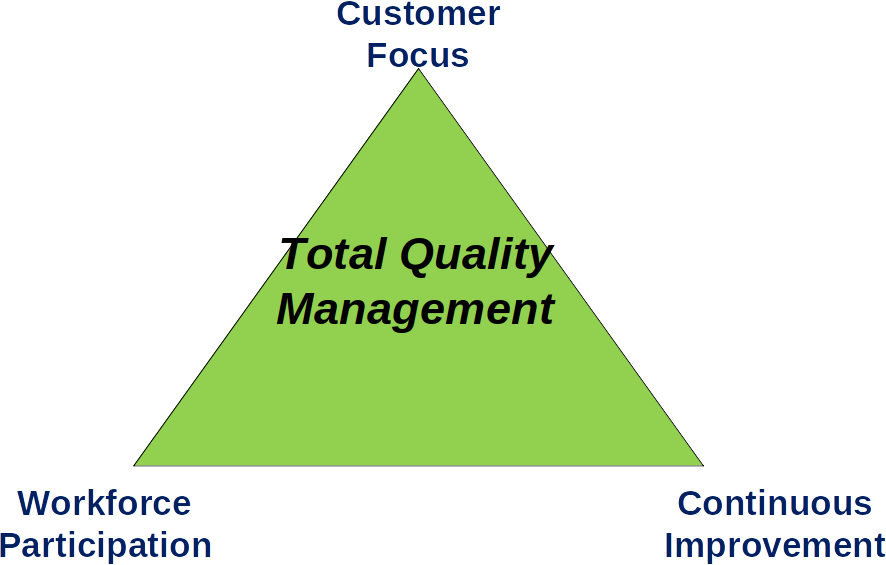
The three key ingredients for companies to be competitive in its products & services are
1) Customer Focus – Understanding the needs and requirements of target customer segments
2) Continuous Improvement – Continuously improve products, services & processes to meet the evolving needs of the customers
3) Workforce participation – Get the entire workforce involved to work together on delivering quality and making continuous improvement.
It is easy to see the potency of this combination. We can only deliver quality products that win the heart of customers if we first understand customers’ needs. And we can only stay ahead of our competitors if we consistently improve on the value we deliver by getting our teams to work together. However, in big organisations, more considerations are needed in view of the complexity of issues involved. That is when the Business Excellence Model comes into the picture.
The most famous of the Business Excellence Models are
- Deming Prize, established by Japan in 1951 to honor Dr Edwards Deming,
- Malcolm Baldrige National Quality Award (MBNQA), established by the United States in 1987 to boost competitiveness of its enterprises.
- European Foundation for Quality Management (EFQM) model, established by the European Union in 1989 to increase competitiveness of the European economy.
The MBNQA framework is often adapted by other countries to establish each’s own national quality award framework. This includes Singapore Quality Award, China Quality Award, Japan Quality Award, and Thailand Quality Award etc.
The Business Excellence Model, such as the MBNQA, has expanded on the traditional concepts of Total Quality Management, to cover fuller spectrum of modern management theories and discoveries. Lets take the MBNQA framework below as example.
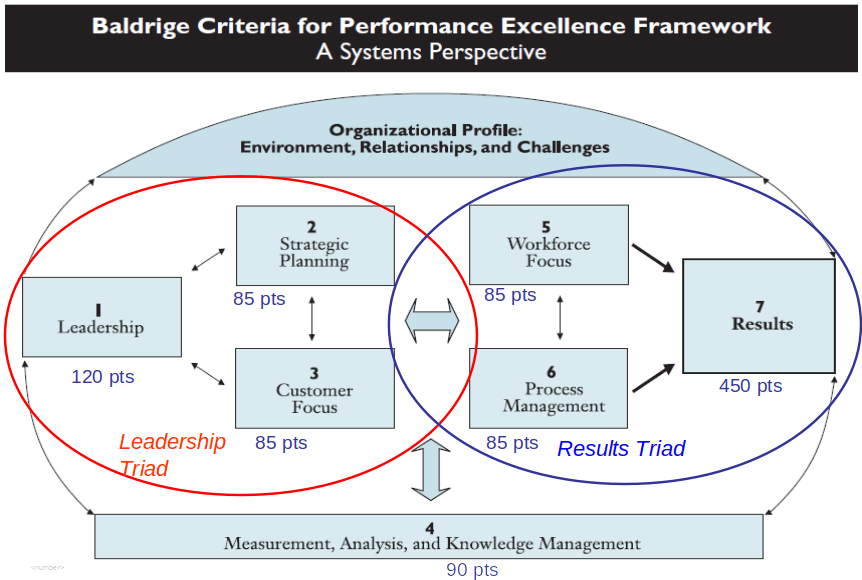
Under the MBNQA model, an organisation needs to address critical success factors of its business, in order to be competitive. It has to develop and deploy strong and effective system for
- Leadership
- Strategic Planning
- Customer Focus
- Measurement, Analysis and Knowledgement Management
- Workforce Focus
- Process Management
All these major areas must be embeded with continuous learning and improvement, and they will in turn drive key business results in category 7. Category 1 to 3 provides direction for the company, and they are also known as “Leadership Triad”, while Category 5 to 7 directly drive results and are known as “Results Triad”.
I have used Business Excellence Model in assessment and in driving organisational improvement. I personally find it to be a very useful tool that enables organisations to identify where they are in development, and to identify where opportunities for improvement are. But it is a pity that many organisations only use the framework for national quality award purposes, much like students studying only to pass exams. This is a waste.
The best way for organisations to derive real and lasting benefit, is to embed Business Excellence as an integral part of the organisation’s work. Use it educate and develop managers and leaders. Use it to conduct periodic organisational reflection, benchmarking, and plan for improvement. Only then, can the organisation achieve true world-class performance and competitiveness, and deliver value to its customers and stakeholders .
 A reflection of David K